



Canada’s housing market has been a topic of intense discussion for years. In many regions, home prices have increased over the past decade, prompting concerns about a property bubble. A property bubble occurs when prices rise well above underlying economic fundamentals, like household incomes, rental yields, and local demand, often driven by speculation and easy access to credit. Understanding the current state of the Canadian housing market is crucial for buyers, investors, and homeowners looking to make informed decisions.
What Is a Property Bubble?
A property bubble happens when housing prices climb rapidly, outpacing factors like income growth and rental value. If the bubble bursts, prices can fall sharply, creating financial risk for homeowners and investors. Key signs of a bubble include:
- Prices rising faster than incomes.
- High household debt relative to earnings.
- Speculative investment activity.
- Affordability challenges for first-time buyers.
In Canada, recent trends show some cooling, but risks remain in certain markets and segments, especially in major urban centres.
Current Canadian Market Trends
Recent data highlights several factors shaping the property market today:
- Price Adjustments: Home prices in major cities are still below their 2022 peaks, with Toronto down roughly 12% and Hamilton down 16%. Despite this decline, affordability remains a concern in many regions.
- Mortgage Renewals: Over one-third of Canadian mortgages will come up for renewal by 2026, many at significantly higher interest rates, which could affect household budgets and borrowing power.
- Household Debt and Imbalances: The Bank of Canada continues to flag high household debt and real estate imbalances as top financial risks for the economy.
- Rental Market Pressures: Condo supply is increasing in Toronto, Vancouver, and London. In Toronto, roughly 70% of new rental units are reportedly losing money monthly, which affects investor behaviour and rental returns.
- Buyer Sentiment: Confidence among buyers has weakened, with many expecting further price drops and opting to wait on the sidelines rather than entering the market.
- Affordability: While homeownership is slightly more attainable compared to the past, costs remain high, particularly in Vancouver, where ownership expenses now exceed 90% of median household income.
- Regional Variations: Smaller markets, such as Kelowna and Victoria, experience higher volatility, while Montreal and Ottawa show more stable conditions.
- Investor Behaviour: Investor sentiment has shifted from optimistic growth strategies to a focus on cash flow and sustainable returns, reshaping local housing demand.
- Immigration Impacts: Federal reductions in immigration targets are expected to dampen housing demand growth through 2026, further affecting market dynamics.
These trends collectively suggest a cooling market, but not necessarily a collapse. Different regions and property types are experiencing varied risks and opportunities.
Canada’s Housing Market Mirrors the 2007 U.S. Real Estate Bubble
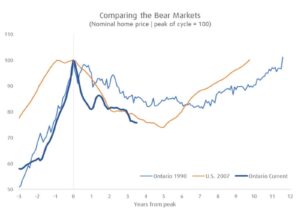
The chart highlights a surprising trend for many observers. Despite Ontario experiencing record population growth starting in 2022 and peaking in 2023, home prices have been declining for over three years. What’s striking is how closely the current trajectory mirrors the U.S. housing market during the 2007 crash. Even Canada’s state-owned mortgage insurer has suggested this time might be different, but history often proves otherwise.
The more crucial insight lies in the duration of the cycle. Ontario’s current path resembles the U.S. crash, suggesting it could take another five years to fully recover. By comparison, Ontario’s previous historical cycle took eight years to rebound. The U.S. downturn was steeper, which, paradoxically, allowed affordability to improve and the market to stabilize more quickly.
Signs of Overvaluation and Bubble Risk
Several indicators suggest caution for buyers and investors:
- Price-to-Income and Price-to-Rent Ratios
High ratios indicate that buying may be less financially attractive than renting, particularly in large urban markets. - Debt Levels
Canadians carry high household debt, often tied to mortgages, increasing vulnerability to rate changes and economic slowdowns. - Speculative Activity
In some cities, investment-driven purchases still influence price trends, though investor behaviour is shifting toward cash flow discipline rather than speculative growth. - Market Volatility
Smaller or rapidly growing markets face higher price swings, while larger, more stable cities show slower, steadier adjustments.
What Buyers and Investors Should Consider
Whether you’re purchasing your first home, upgrading, or selling a condo downtown, local market conditions should guide your decisions. Consider these strategies:
- Assess Affordability: Ensure mortgage payments remain manageable, even if interest rates rise at renewal.
- Understand Regional Differences: Prices, volatility, and rental yields vary widely across Canada. Smaller markets may offer growth potential but come with higher risk.
- Evaluate Long-Term Goals: Buying for long-term stability is safer than speculating on short-term price appreciation.
- Monitor Interest Rates and Policy Changes: Keep an eye on Bank of Canada announcements and federal housing policies, as they influence borrowing costs and market behaviour.
- Look at Supply and Demand Fundamentals: In cities like Toronto and Vancouver, rising condo supply may impact rental and resale dynamics.
Using a Risk Map for Your Decisions
Think of current housing data as a “real estate weather map.” It helps buyers and investors understand:
- Where risks are concentrated.
- When to negotiate harder.
- When to hold off on purchases.
By looking at fundamentals like affordability, market volatility, and regional demand, Canadians can make informed choices about buying, selling, or holding properties.
Canada’s housing market is complex, with cooling trends, regional differences, and changing investor sentiment. While major cities have seen price declines from 2022 highs, affordability remains a challenge for many Canadians. Mortgage renewals, interest rates, and household debt are key factors to watch.
Understanding local conditions, assessing risks carefully, and planning for the long term can help Canadians navigate the housing market wisely, whether buying, selling, or investing.