Many first-time buyers spend months, sometimes years, saving for a down payment, only to discover late in the process that the down payment is not the only cash they need. Closing costs can add thousands of dollars to the amount required on closing day. Without a plan for them, they can delay a purchase, force a last-minute scramble for funds, or leave you without a cushion once you move in.
The good news is that closing costs are predictable once you know what to expect. In this guide, I break down the closing costs for first-time home buyers in Ontario, explain which rebates can reduce them, and show how to build them into a realistic home-buying budget.
What Are Closing Costs for a Home in Ontario?
Closing costs when buying a home in Ontario are the one-time fees and taxes you pay to complete the purchase, on top of your down payment. They cover the legal transfer of the property, taxes owed to the province, professional services, and adjustments with the seller.
Most closing costs are due on or shortly before closing day and are paid through your real estate lawyer. A few, such as the home inspection, are paid earlier in the process. Unlike your down payment, most of these costs do not build equity. They are simply the price of completing the transaction.
Because they affect how much cash you need, closing costs also affect how much you can spend on the home. My guide on how much house you can afford in Ontario explains how they fit into the bigger affordability picture.
How Much Should First-Time Buyers Budget for Closing Costs?
So, how much are closing costs in Ontario? The Government of Canada suggests budgeting between 1.5% and 4% of the purchase price. On a $500,000 home, that is roughly $7,500 to $20,000.
Where you land in that range depends on several factors:
- Purchase Price: Land transfer tax rises with the price.
- Location: Toronto buyers pay a second municipal land transfer tax.
- First-Time Buyer Status: Rebates can significantly reduce the tax.
- Down Payment Size: Buyers with less than 20% down pay provincial sales tax on the mortgage default insurance premium.
- Property Type: New builds and condos can carry extra charges.
When deciding how much to budget for closing costs, I generally suggest planning toward the higher end of your estimate. Any money left over can go straight into your emergency fund. Lenders also typically want to see that you have funds set aside for closing costs, often at least 1.5% of the purchase price, before they approve your mortgage. My closing fees calculator can give you a quick estimate for a specific price.
What Closing Costs Do First-Time Home Buyers Need to Pay?
Here is a closer look at the most common first-time home buyer closing costs in Ontario and what each one covers.
Land Transfer Tax
Ontario’s land transfer tax is usually the largest closing cost. It is calculated on the purchase price using these marginal rates:
- First $55,000: 0.5%
- $55,000 to $250,000: 1.0%
- $250,000 to $400,000: 1.5%
- $400,000 to $2,000,000: 2.0%
- Over $2,000,000 (One- or Two-Family Homes): 2.5%
On a $500,000 home, the provincial tax works out to $6,475. Buyers in the City of Toronto also pay a municipal land transfer tax at similar rates. The land transfer tax for first-time home buyers in Ontario can be reduced through rebates, which I cover below.
Legal Fees and Disbursements
Your real estate lawyer handles the title search, prepares and registers documents, registers the mortgage, arranges title insurance, and transfers funds. Legal fees when buying a house in Ontario often range from about $1,500 to $2,500 or more once disbursements and HST are included. Disbursements are the out-of-pocket costs your lawyer pays for you, such as registration fees and searches.
Always ask for an all-in quote so you can compare lawyers fairly.
Home Inspection
A home inspection typically costs between $400 and $700, with higher fees for larger or rural properties. Inspections of wells, septic systems, or sewer lines cost extra. Although it is optional, I strongly recommend an inspection for resale homes. It is one of the best ways to avoid an expensive surprise after you move in.
Title Insurance
Most lenders require title insurance. It protects against problems such as title fraud, survey errors, or undisclosed liens. It is a one-time premium, usually a few hundred dollars, arranged through your lawyer.
Appraisal Fees
Your lender may require an appraisal to confirm the property’s value supports the mortgage. Appraisals typically cost $300 to $600. On many insured mortgages, the lender or insurer covers the valuation, but you should confirm this early.
Property Tax and Utility Adjustments
If the seller has prepaid property taxes or certain utilities beyond your closing date, you reimburse them for your share. Your lawyer calculates these adjustments, and they appear on your statement of adjustments. Depending on the closing date, the amount can range from a few dollars to a few thousand.
Other Potential Closing Costs
Depending on your purchase, you may also face:
- PST on Mortgage Default Insurance: In Ontario, the 8% provincial sales tax on the insurance premium is due at closing and cannot be added to the mortgage.
- Home Insurance: Your lender requires coverage to be in place before closing.
- Condo Status Certificate: The fee for this report is capped by regulation, and your lawyer should review it before your offer becomes firm.
- New-Build Charges: Development charges, utility connection fees, Tarion enrolment, and HST adjustments may apply. Buyers of qualifying new homes should review the GST/HST rebate for first-time home buyers before signing.
- Moving and Setup: Movers, utility hookups, locksmiths, and basic furnishings.
How First-Time Home Buyer Rebates Can Reduce Closing Costs
First-time buyers have two valuable tools to reduce what they pay at and after closing.
Ontario Land Transfer Tax Refund
The first-time home buyer land transfer tax rebate in Ontario refunds up to $4,000 of provincial land transfer tax. In practical terms, eligible buyers pay no provincial land transfer tax on the first $368,000 of the purchase price. On a $500,000 home, the $6,475 tax drops to $2,475.
To qualify, you must:
- Be at least 18
- Occupy the home as your principal residence within nine months
- Have never owned a home, or an interest in a home, anywhere in the world
Your spouse also cannot have owned a home while you were together. If you buy with someone who is not a first-time buyer, the refund is reduced in proportion to your ownership share. Your lawyer usually claims this Ontario first-time home buyer rebate at registration, so it reduces the amount you pay at closing rather than arriving later. Toronto offers a separate municipal rebate for eligible first-time buyers.
First-Time Home Buyer Tax Credit
The federal home buyers’ amount lets eligible first-time buyers claim $10,000 on their income tax return. The credit is calculated at the lowest federal tax rate, so it is worth up to $1,400 for a 2026 purchase. It does not reduce what you pay on closing day, but it does lower your tax bill for the year you buy.
My first-time home buyer mortgage guidance covers other programs worth considering, including the First Home Savings Account (FHSA) and the Home Buyers’ Plan (HBP).

How Closing Costs Affect Your Down Payment Budget
Closing costs come out of the same savings as your down payment. This is where many first-time home buyer budgets in Ontario get stretched.
Suppose you have $35,000 saved and plan to put 5% down on a $600,000 home. The minimum down payment is $35,000, which uses all of your savings. That leaves nothing for closing costs, so the purchase may not work as planned. In this situation, a slightly lower price, more time to save, or a documented family gift may be needed.
For buyers who are new to Canada, lenders may also ask for a longer history of savings or documentation of funds transferred from abroad. Planning ahead avoids delays when proving both your down payment and closing funds.
Example: Calculating Your Total Home Buying Budget
Here is an illustration of how much money you need to buy a house in Ontario once closing costs are added to the down payment. It assumes a first-time buyer purchasing a $500,000 resale home outside Toronto with 5% down and a 25-year insured amortization.
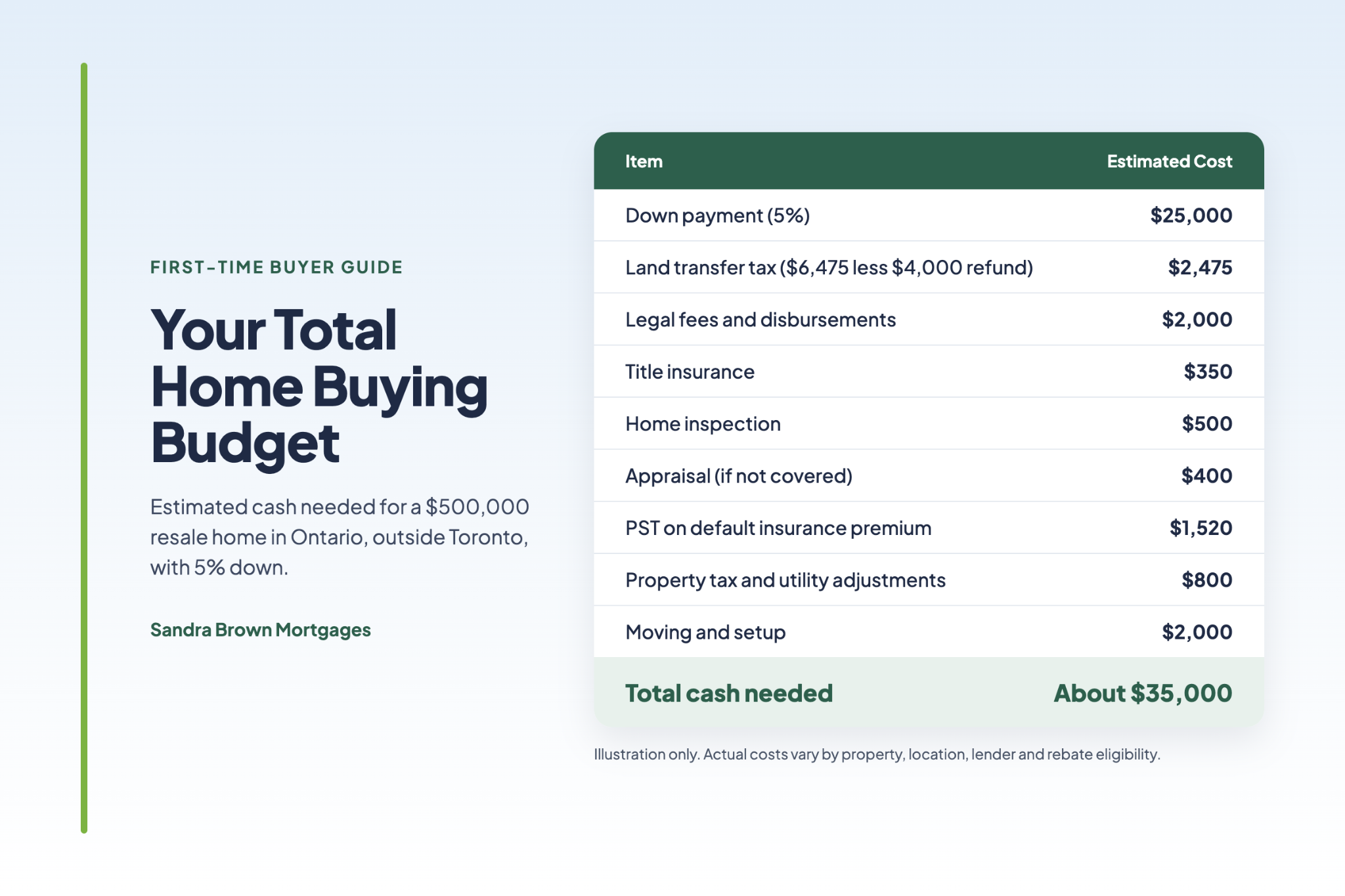
In this example, closing costs and moving expenses add about $10,000 on top of the $25,000 down payment. I would also recommend keeping an emergency reserve, ideally a few months of expenses, after closing.
Your own figures will vary by property and location. My guide to the best places to buy a home in Eastern Ontario compares prices across communities where these Ontario home buying costs can be lower.
How to Prepare for Closing Costs as a First-Time Buyer
A little preparation goes a long way. Here are the steps I recommend:
- Keep Closing Funds Separate: Use a dedicated savings account so these funds are not mixed with everyday spending.
- Get Quotes Early: Contact a real estate lawyer and home inspector before you make offers.
- Check Your Rebate Eligibility: Confirm your first-time buyer status, especially if you are buying with someone who has owned before.
- Document Your Funds: Keep 90 days of bank statements and gift letters ready, because lenders verify the source of all funds.
- Avoid New Debt: Do not finance a car or furniture before closing, since it can affect your approval.
Pre-approval is the right time to confirm all of this. My guide on what happens after mortgage pre-approval walks through the steps between approval and closing day.
Can Closing Costs Be Included in Your Mortgage?
Generally, no. Most closing costs, including land transfer tax and legal fees, must be paid from your own funds. The main exception is the mortgage default insurance premium, which is usually added to the mortgage. However, the PST on that premium must still be paid in cash at closing.
Some lenders offer cash-back mortgages, which pay a percentage of the mortgage amount at closing that can help cover costs. These products often come with a higher rate and repayment conditions if you break the mortgage early. This is one reason the “best rate” isn’t always the best choice: the full terms matter as much as the rate itself.
Buyers using an alternative mortgage should also expect lender fees, often around 1% of the mortgage, and should budget for them as part of their home buying expenses in Ontario.
Some buyers expect to tap their equity soon after closing for repairs. With 5% down, there is usually little equity available for a HELOC in the early years, so it is safer to plan without one.
How a Mortgage Broker Can Help You Plan for Closing Costs
When I work with first-time buyers, I estimate your complete cash requirement, not just your down payment. That includes land transfer tax after rebates, legal and inspection costs, insurance-related taxes, and adjustments. You will know exactly how much you need before you make an offer.
I also compare lenders to find one whose appraisal policies, fees, and product features fit your situation. I help you choose a structure that suits your plans, whether that means comparing fixed and variable mortgage rates or timing your rate hold. Understanding how economic conditions can affect mortgage rates can also help you decide when to lock in.
Plan for the Full Cost, Not Just the Down Payment
Closing costs are a normal part of buying a home, and with the right plan, they do not need to be a source of stress. When you know what to expect, claim the rebates you are entitled to, and keep your closing funds separate, you can reach closing day with confidence and a cushion for life in your new home.
If you are preparing to buy your first home, contact me for a personalized estimate of your total cash requirement. Together, we can build a budget that covers every cost and a mortgage plan that supports your future.
Frequently Asked Questions
1. How much should I save for closing costs in Ontario?
Plan for 1.5% to 4% of the purchase price. On a $500,000 home, that means roughly $7,500 to $20,000, depending on your location, rebate eligibility, down payment, and property type.
2. Do first-time home buyers pay land transfer tax in Ontario?
Yes, but eligible first-time buyers can receive a provincial rebate of up to $4,000. As a result, they pay no provincial land transfer tax on homes up to $368,000. Toronto buyers may also qualify for a municipal rebate.
3. What is the biggest closing cost when buying a home?
For most Ontario buyers, the biggest closing cost is land transfer tax, followed by legal fees. For buyers with less than 20% down, the PST on the default insurance premium can also be significant.
4. Can I use my down payment savings to pay closing costs?
You can, but the money cannot be counted twice. Lenders need to see enough funds for the full down payment plus closing costs. If your savings only cover one, you may need to adjust the purchase price or add to your savings.
5. Can closing costs be added to a mortgage?
Generally, no. Only the default insurance premium is usually added to the mortgage. Cash-back mortgages are one alternative. Down the road, mortgage refinancing or the options compared in my guide to HELOC versus refinancing may help homeowners access equity, but these are not ways to fund closing itself.
6. When do I have to pay closing costs?
Most closing costs are paid to your lawyer a few days before closing, usually by wire transfer or certified funds. The home inspection and any appraisal are typically paid earlier, during your offer’s condition period.