
“How much do I need to earn to buy a home?” This is one of the first questions I hear from buyers across Ontario. It is a reasonable question, but the honest answer is that no single salary guarantees approval. Lenders do not just look at your paycheque. They look at how your income compares with your housing costs, your other debts, your down payment, your credit history, and the higher interest rate you must qualify at under federal rules.
That is why two people earning the same amount can qualify for a mortgage in Ontario at very different levels. One may be approved for $450,000. The other, with a car loan and higher property taxes, may be approved for considerably less.
In this guide, I explain how lenders assess the income to qualify for a mortgage in Ontario, what counts as qualifying income, how debt ratios and the stress test work together, and what you can do to improve your numbers before you apply.
Is There a Minimum Income to Qualify for a Mortgage in Ontario?
There is no official minimum income to get a mortgage in Ontario. Neither the federal government nor lenders publish a salary floor that every borrower must meet. Instead, lenders set mortgage income requirements in Ontario by measuring whether your income can comfortably support the specific mortgage, property, and debt load you are applying for.
In practice, this means your minimum income depends on three things:
- The size of the mortgage you need
- The carrying costs of the property you are buying
- The monthly debt payments you already have
A buyer purchasing a modest condo in a lower-priced community with no other debt may qualify on a moderate single income. A buyer purchasing a detached home with high property taxes and a car payment will need considerably more. Lenders also want to see that your income is stable and verifiable, which matters just as much as the amount.
If you are buying your first home, my guidance on getting a first-time home buyer mortgage explains how the full qualification process works from start to finish.
How Much Income Do You Need Based on the Mortgage Amount?
If you are wondering how much income you need to qualify for a mortgage in Ontario, the most practical approach is to work backwards from the mortgage amount. Lenders calculate a qualifying payment at the stress-test rate, add your property taxes and heating costs, and then compare the total with your gross income.
Here is an illustration. It assumes a 25-year amortization, a 6.25% qualifying rate, $350 per month in property taxes, $150 per month for heating, and no other debts:
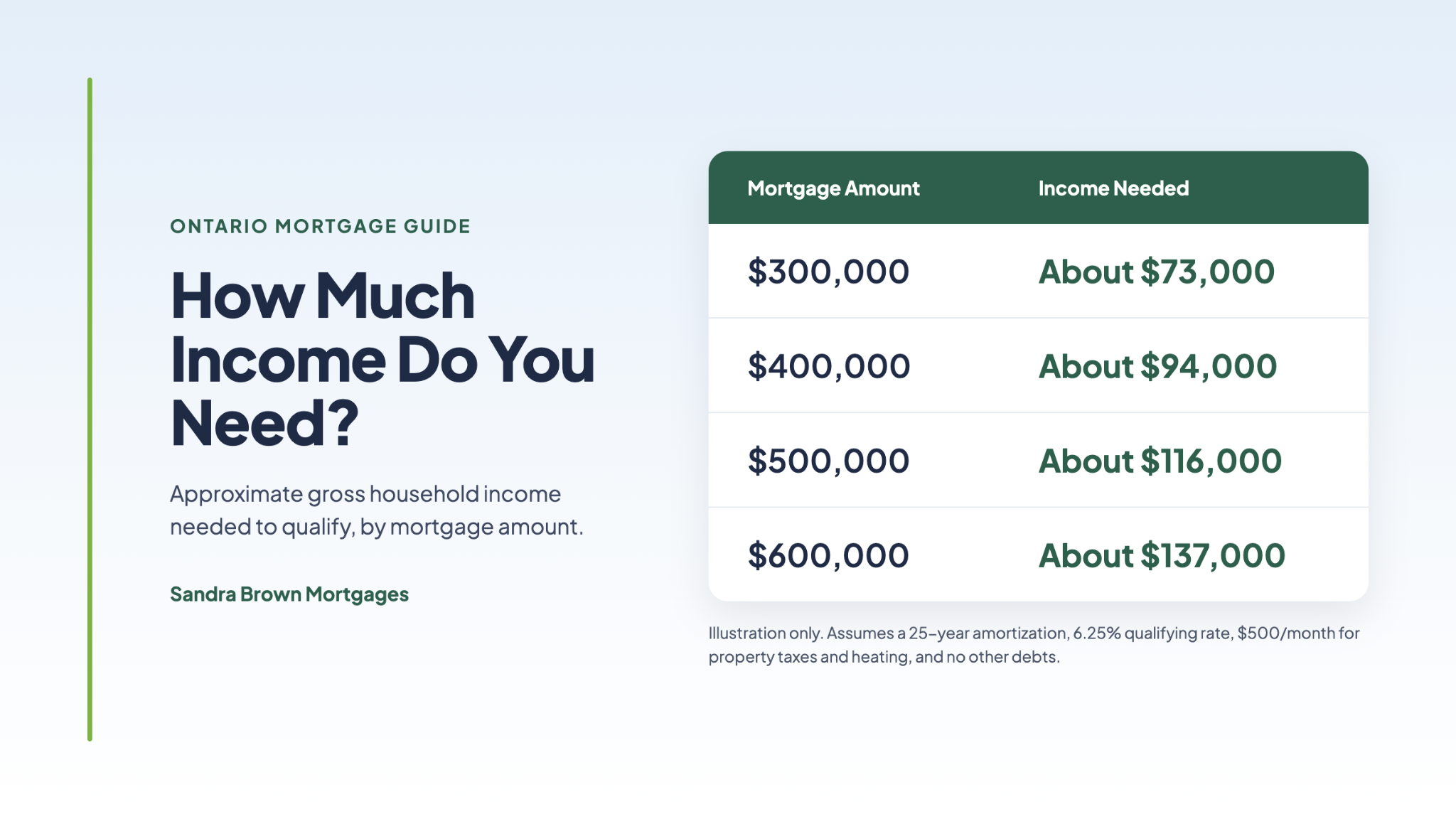
So, what is the income needed for a $500,000 mortgage in Ontario? Under these assumptions, it is roughly $116,000 per year. If you are an eligible first-time buyer using a 30-year insured amortization, the figure drops to roughly $109,000. A car loan, a student loan, or higher property taxes would push it higher.
These numbers are examples, not approvals. To estimate your own range, my affordability calculator is a good starting point. My guide on how much house you can afford in Ontario also explains the difference between what a lender may approve and what you can comfortably carry.
What Do Ontario Mortgage Lenders Look At?
Your income is only one part of the picture, so here are the five factors lenders weigh together when deciding how much you can borrow.
Gross Income
Lenders use your gross income, which is your earnings before taxes and deductions, not your take-home pay. It must be verifiable through pay stubs, an employment letter, T4 slips, or Notices of Assessment, depending on how you earn it. Couples applying together can combine their incomes, which often makes a significant difference.
Existing Debts
Every recurring debt payment reduces the room available for your mortgage. This includes:
- Car loans and leases
- Student loans
- Credit card balances
- Personal lines of credit
Lenders typically count a minimum payment of about 3% of a credit card or unsecured line of credit balance, even if you pay it off every month. A secured line of credit counts too. If you already carry a home equity line of credit (HELOC) on another property, its payment is included in your debt calculation.
Down Payment
Your down payment determines how much you need to borrow and whether mortgage default insurance is required. In Canada, the minimum down payment for a home under $1.5 million is 5% of the first $500,000 and 10% of the portion above that. A down payment under 20% requires default insurance, and the premium is usually added to the mortgage.
A larger down payment lowers the mortgage amount, and with it the income you need to qualify. Buyers of qualifying new builds should also review the GST/HST rebate for first-time home buyers. It can reduce the overall cost of the purchase, although it does not replace the down payment itself.
Credit History
Your credit score and history affect which lenders will work with you and at what rate. Prime lenders generally look for a solid score, consistent on-time payments, and reasonable credit utilization. A weaker credit profile does not always prevent approval, but it can narrow your options or lead to a higher rate, which in turn affects qualification.
Property Taxes and Other Housing Costs
Lenders include property taxes, heating costs, and 50% of any condo fees in your housing costs. This is why the same income can support a higher purchase price in one community than in another. My guide to the best places to buy a home in Eastern Ontario compares several communities where carrying costs and prices can stretch a budget further.
How Debt Ratios Affect the Income You Need
Lenders use two debt service ratios to turn your income and expenses into a clear yes-or-no answer. Together they form the core of mortgage qualification in Ontario.
Gross Debt Service (GDS)
Your GDS ratio measures your housing costs as a percentage of your gross monthly income. Housing costs include the qualifying mortgage payment, property taxes, heating, and half of any condo fees. For insured mortgages, the maximum GDS is generally 39%.
For example, a household earning $90,000 per year has $7,500 in gross monthly income. At 39%, it can have up to $2,925 per month in qualifying housing costs.
Total Debt Service (TDS)
Your TDS ratio adds all your other monthly debt payments to your housing costs. For insured mortgages, the maximum is generally 44%. This is the debt-to-income ratio for an Ontario mortgage that most often limits buyers, because consumer debt adds up quickly.
Using the same $90,000 household, 44% allows $3,300 per month in total debt payments. If the household carries a $600 car payment, only $2,700 remains for housing. That is less than the $2,925 GDS limit, so the car loan, not the housing costs, becomes the deciding factor.
Conventional mortgages with 20% or more down may be assessed against slightly different lender limits, so the exact thresholds depend on the lender and the file.
How the Mortgage Stress Test Affects Income Requirements
The mortgage stress test in Ontario requires you to qualify at a higher interest rate than the one you will actually pay. For federally regulated lenders, the qualifying rate is the greater of 5.25% or your contract rate plus two percentage points.
If your negotiated rate is 4.25%, your debt ratios are calculated at 6.25%. On a $500,000 mortgage with a 25-year amortization, that is the difference between an actual payment of roughly $2,700 and a qualifying payment of roughly $3,270. Because qualification is based on the higher payment, the stress test meaningfully raises the income you need.
This also means your borrowing power changes as rates move, even if your income stays the same. Checking current mortgage rates before you shop gives you a realistic starting point. Your choice of product matters too, and my comparison of fixed versus variable mortgage rates explains the trade-offs.

What Counts as Income for a Mortgage in Ontario?
Lenders treat different types of income differently, so the way you earn money matters as much as how much you earn.
Employment Income
Salaried and full-time hourly employees usually have the simplest path. Lenders generally verify your income with a recent pay stub and an employment letter showing your position, start date, and pay. A few points to keep in mind:
- Probation: Some lenders will not proceed until your probationary period ends, although exceptions exist for people continuing in the same field.
- Variable Pay: Overtime, bonuses, and commissions are usually averaged over two years.
- Part-Time and Contract Work: These generally require a consistent history, often two years.
Self-Employment Income
Self-employed borrowers are typically asked for two years of T1 Generals and Notices of Assessment. Lenders usually average the net income from those years. This can be a challenge because legitimate business write-offs reduce your taxable income, and that lower figure is the one lenders use.
Some lenders offer programs that consider stated income or business cash flow for established self-employed borrowers. In other cases, an alternative mortgage may be a better fit when a strong business does not show up fully on tax returns.
Other Qualifying Income
Depending on the lender and the documentation, other income sources may also count:
- Rental Income: From a suite or investment property, usually through an offset or a percentage of the rent.
- Pension Income: Including CPP, OAS, and workplace pensions.
- Child and Spousal Support: Payments supported by a court order or separation agreement.
- Canada Child Benefit: Some lenders count it, depending on the children’s ages and remaining eligibility.
- Long-Term Disability: Benefits with confirmed ongoing payments.
Can You Qualify for a Mortgage With a Lower Income?
Yes, it is often possible, though it usually takes more planning. Buyers with lower incomes typically succeed by keeping their other debts to a minimum, saving a larger down payment, choosing a property with lower carrying costs, or adding a co-borrower. Eligible first-time buyers may also benefit from a 30-year amortization on an insured mortgage, which lowers the qualifying payment.
Location makes a real difference as well. My analysis of whether now is a good time to buy in Kingston looks at local prices and conditions, which helps buyers see how far their income can go in a specific market.
When traditional lenders cannot approve a file, a short-term private mortgage can sometimes bridge the gap. These loans come with higher rates and fees, so I only recommend them with a clear exit plan, such as rebuilding credit and moving to a traditional lender at renewal.
How to Increase Your Mortgage Qualification Amount
If your current numbers fall short, these steps can improve your position before you apply.
- Pay Down Revolving Debt: Reducing a credit card balance can free up qualification room quickly, because lenders count a monthly payment of about 3% of the balance.
- Avoid New Credit: Hold off on financing a vehicle or opening new accounts until after you close.
- Add a Co-Borrower or Guarantor: A spouse’s or family member’s income can strengthen the application, but everyone signing takes on legal responsibility.
- Document All Your Income: Make sure every eligible income source is properly recorded and supported.
- Increase Your Down Payment: A First Home Savings Account (FHSA), the Home Buyers’ Plan, or a documented gift from family can all help.
- Compare More Than the Rate: A lower rate reduces the qualifying payment, but terms matter too. This is why the “best rate” isn’t always the best choice.
If you already own a property and are planning your next purchase, mortgage refinancing to consolidate high-interest debt may improve your ratios. It needs to be weighed against penalties and the total cost.

How a Mortgage Broker Can Help You Determine How Much You Qualify For
Every lender calculates income a little differently. One may average your bonuses, another may accept your rental income, and another may be more flexible with self-employment documentation. As a broker with access to dozens of lenders, I can match your file to the lender whose guidelines best reflect your real income, which can make a significant difference to the amount you qualify for.
I also help you understand how much mortgage you can afford based on income, not just the maximum a lender will approve. Once your numbers are reviewed, a pre-approval turns the estimate into a working budget. My guide on what happens after mortgage pre-approval explains the next steps. Because rates shift with the broader market, it also helps to understand how economic conditions can affect mortgage rates while you plan.
Know Your Numbers Before You Shop
The income you need to buy a home in Ontario is not a fixed figure. It is the result of your income, debts, down payment, credit, the property’s carrying costs, and the stress-test rate, all working together. Understanding how those pieces fit lets you shop with confidence instead of guessing.
If you would like a clear picture of what you qualify for, contact me for a personalized review. We will look at your real numbers, identify ways to strengthen your application, and build a mortgage plan that fits both your budget and your goals.
Frequently Asked Questions
1. What Is the Minimum Income Needed to Qualify for a Mortgage in Ontario?
There is no fixed minimum. Lenders assess whether your verifiable income can support the mortgage payment, property taxes, heating, and your other debts within their GDS and TDS limits, calculated at the stress-test rate.
2. How Much Income Do I Need for a $500,000 Mortgage in Ontario?
With no other debts, a 6.25% qualifying rate, a 25-year amortization, and about $500 per month for property taxes and heating, you would need roughly $116,000 in gross household income. A 30-year amortization lowers that to about $109,000, while existing debts raise it.
3. Can I Get a Mortgage With a Low Income?
Often, yes. Keeping your other debts low, saving a larger down payment, choosing a lower-cost property, and adding a co-borrower all improve your chances. Some buyers also qualify through alternative lenders.
4. Does My Spouse’s Income Count Toward Mortgage Qualification?
Yes. If your spouse is on the application, lenders combine both incomes. They also include both of your debts and credit histories in the assessment.
5. Can Self-Employed People Qualify for a Mortgage in Ontario?
Yes. Most lenders want two years of tax documents and average your net income over that period. Self-employed borrowers whose taxable income understates their real earnings may have additional programs and alternative lending options available.
6. Does My Credit Score Affect How Much Mortgage I Can Qualify For?
Indirectly, yes. Your credit score affects which lenders you can access and the rate you are offered. Because the stress-test rate is based on your contract rate, a higher rate reduces the amount you qualify for.
7. How Does Debt Affect the Income I Need for a Mortgage?
Every monthly debt payment counts toward your TDS ratio, so more debt means you need more income to qualify for the same mortgage. Homeowners weighing ways to restructure debt can compare HELOC and refinancing to see which approach fits.
8. How Can I Find Out How Much Mortgage I Qualify For?
An online calculator can give you a rough idea, but a broker review of your actual income documents, debts, credit, and down payment is the most reliable way to know. A pre-approval then confirms your price range before you start making offers.