



For many Canadian homeowners, years of mortgage payments and rising property values have created meaningful equity. Whether you are renovating, consolidating higher-interest debt, covering a major expense, or simply want access to funds as needs arise, the next question is how to use that equity efficiently.
Two of the most common options are a home equity line of credit and mortgage refinancing. When comparing a home equity line of credit (HELOC) and refinancing in Canada in 2026, the interest rate matters, but it is only one part of the decision.
As of July 15, 2026, the Bank of Canada had maintained its policy rate at 2.25%, where it has remained since October 2025, while the prime rate remained at 4.45%. Some fixed refinance rates are currently lower than typical HELOC rates, depending on the lender and term, but that does not automatically make refinancing the better option.
The best way to access home equity in 2026 depends on how much you need, how you plan to use the funds, how quickly you expect to repay them, and whether refinancing would mean giving up a favourable mortgage rate or paying a prepayment penalty.
HELOC and Refinancing: The Key Difference
Both approaches allow homeowners to borrow against equity, but they work very differently. A decision between a home equity line of credit and refinancing often comes down to how you want to access the money and what happens to your existing mortgage.
- HELOC: A revolving line of credit secured against your home. You can borrow, repay, and borrow again up to your approved limit. The interest rate is generally variable and linked to the lender’s prime rate, and you pay interest on the amount you actually use.
- Mortgage Refinance: Your existing mortgage is replaced with a new mortgage. You can increase the mortgage amount to release equity as a lump sum while arranging a new rate, term, and amortization schedule.
- Standalone HELOC: Depending on your mortgage and lender, a separate HELOC may be added without replacing your existing first mortgage. This can be particularly useful when your current mortgage has a favourable rate.
- Readvanceable Mortgage: This combines a mortgage and HELOC. As eligible mortgage principal is repaid, available revolving credit can increase.
If you need a specific lump sum, it is also worth comparing a home equity loan and other equity take-out options. For homeowners deciding between a home equity loan and a HELOC in Canada, the main distinction is usually predictable lump-sum borrowing versus ongoing revolving access.
Where HELOC and Refinance Rates Stand in 2026
Rates can move quickly, so today’s advertised rate should be treated as a snapshot rather than a promise of what every homeowner will qualify for.
With the Bank of Canada’s overnight rate at 2.25% as of July 15, 2026 and major-bank prime at 4.45% in August, HELOC borrowing costs remain closely tied to prime. Ratehub listed several HELOC offers at 4.95% in early August, although the rate available to you will vary by lender, product, and borrower profile.
Mortgage refinance rates in Canada in 2026 also vary considerably by lender, property, equity, credit profile, amortization, and other factors, so they should be compared based on your actual file rather than a market headline.
Why can refinancing price lower? A mortgage is structured as a term loan with scheduled payments, while a HELOC provides flexible, revolving access to funds. That flexibility generally comes at a premium.
There is another important factor: qualification. Federally regulated lenders require borrowers taking out a mortgage refinance or HELOC to pass the mortgage stress test. The qualifying rate is generally the greater of 5.25% or your contract rate plus 2%.
If you are also deciding how to structure the new mortgage itself, my guide to fixed vs. variable mortgages in Canada in 2026 covers the trade-offs in more detail.
The Case for a HELOC in 2026
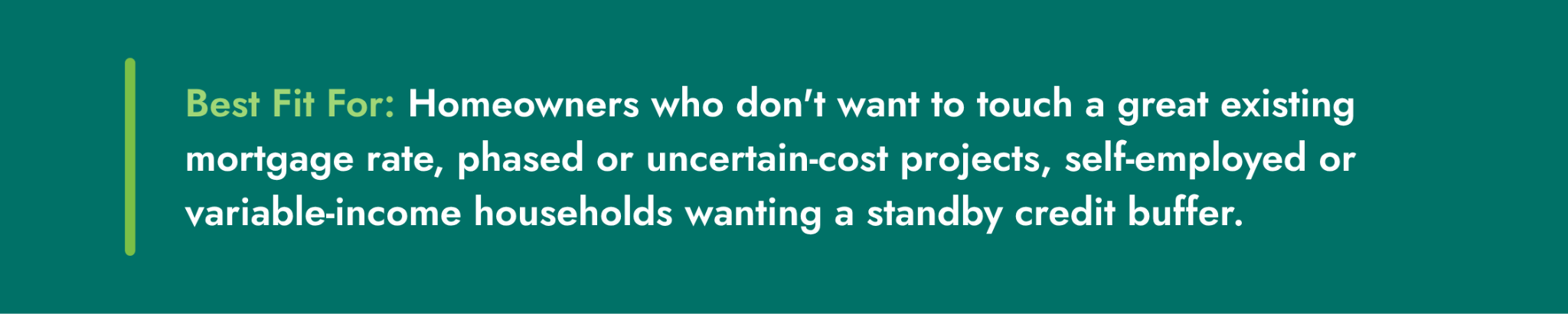
A HELOC can be an excellent option when flexibility matters more than securing the lowest possible interest rate.
One of its biggest advantages is that you do not have to borrow everything at once. If you have a $100,000 HELOC but initially need only $20,000, interest is charged on the amount you have actually drawn rather than the full credit limit.
That makes a HELOC for accessing home equity a practical option when the timing or final cost of an expense is uncertain.
A HELOC may make sense when:
- You Want to Preserve Your Existing Mortgage: If you secured a very favourable mortgage rate several years ago, replacing the entire mortgage just to access additional funds may not be worthwhile.
- Your Costs Will Be Spread Out: Renovations often happen in stages. A HELOC lets you draw funds as invoices arrive instead of borrowing the full projected budget on day one.
- You Want Ongoing Access: After repaying borrowed funds, the available credit can generally be used again without arranging a completely new loan.
- Your Income is Variable: Self-employed homeowners or households with fluctuating income may value having an approved source of credit available as a buffer.
- You Want to Pay Interest Only on Funds Used: This can be attractive when you have access to a larger limit but expect to use only part of it.
- You Want More Repayment Flexibility: In many cases, a HELOC allows you to make larger repayments without the same prepayment restrictions that may apply to an amortized mortgage. This can work particularly well if you expect to receive a lump sum in the near future and want to put it directly toward the balance.
- You Can Stay Within a Budget: A HELOC can work well when you have a clear budget and the discipline to stay within it. Because the available credit is easy to access, it can also be easy to spend more than originally planned.
Another difference is how interest is calculated. In many cases, HELOC interest is calculated on the daily outstanding balance, while amortized mortgage interest is commonly calculated using semi-annual compounding. If you expect to make a significant repayment relatively soon, reducing the HELOC balance can reduce the amount on which daily interest is calculated and may save money in some situations.
Every product has its own guidelines for how interest is calculated and how repayments or prepayments are handled, so these are common structures rather than rules that apply to every HELOC or mortgage.
There is a trade-off. HELOC rates are variable, meaning your borrowing costs can rise or fall with the prime rate. The flexibility can also make it easier to leave a balance outstanding for longer than intended.
A HELOC works best when there is not only a reason for borrowing but also a realistic repayment plan.
The Case for Refinancing in 2026
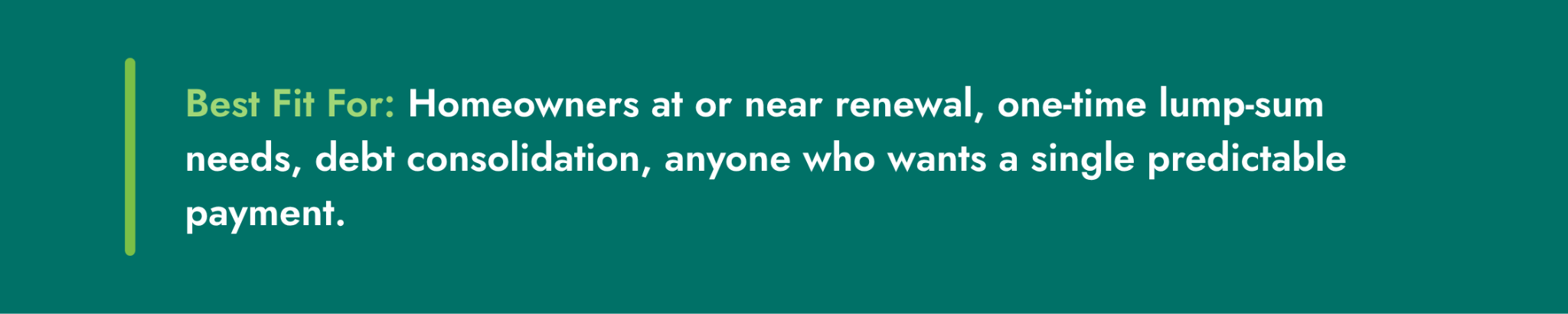
Refinancing can make more sense when you know exactly how much money you need and want to build that amount into a structured mortgage payment.
When comparing a cash-out refinance and a HELOC in Canada, one of the main advantages of refinancing is the ability to borrow a lump sum at a mortgage rate rather than carry a large balance on a revolving HELOC.
A mortgage refinance to access home equity may be worth considering when:
- You Need One Defined Lump Sum: A renovation with a confirmed budget, a separation buyout, education costs, or another major one-time expense can fit naturally into a refinance.
- You are Consolidating Debt: Moving eligible higher-interest balances into mortgage financing may reduce borrowing costs and simplify monthly payments. However, it can also stretch debt over a longer period, so the repayment plan matters. My debt consolidation mortgage guide explains these considerations in more detail.
- You Want Predictable Payments: A fixed-rate refinance can provide a defined payment rather than leaving a large balance exposed to changes in prime.
- You Need to Restructure Your Mortgage Anyway: Refinancing gives you an opportunity to review the mortgage amount, amortization, lender, rate type, and term together.
- You are Near Renewal: If your current term is almost finished, refinancing may allow you to restructure and access equity without the same early-break penalty concern.
For example, suppose you need $80,000 for a completed renovation and expect to repay the money gradually over several years. Carrying the entire balance on a variable HELOC may not be the most efficient structure. Building it into a new mortgage could offer a lower rate and more disciplined repayment.
But that comparison changes significantly when your mortgage still has several years remaining.
The Factor Most People Overlook: The Cost of Breaking Your Mortgage
A lower refinance rate does not necessarily mean a lower total cost. If you refinance before the end of a closed mortgage term, you will normally have to pay a prepayment penalty. The amount depends on your mortgage type, lender, outstanding balance, rate, and time remaining in the term.
A mortgage refinance penalty in Canada can easily change the outcome of a HELOC-versus-refinance calculation.
With many variable-rate mortgages, the penalty is commonly based on approximately three months’ interest. With fixed-rate mortgages, lenders commonly calculate the penalty using the greater of three months’ interest or an interest rate differential (IRD). The exact calculation varies by lender.
An IRD can be significant, particularly on a large mortgage balance. This is where a standalone HELOC can have a major advantage. If it can be arranged while leaving your current mortgage intact, you may be able to access equity without triggering the penalty that would come from replacing the mortgage.
Before assuming refinancing is cheaper because its rate is 0.25% or 0.50% lower, we need to compare:
- The mortgage penalty
- HELOC and refinance rates
- Legal, appraisal, discharge, or setup costs
- How much you actually need to borrow
- How long you expect to carry the balance
- The interest cost over your expected repayment period
I have a more detailed guide to breaking down mortgage penalties before breaking your mortgage if you want to understand how those costs can affect the decision.
The practical rule is simple: calculate the penalty and break-even point before choosing refinancing based on rate alone.
HELOC or Refinance? A Simple Decision Framework
When homeowners ask about accessing home equity in Canada, these questions usually narrow the options quickly.
Choose a HELOC if:
- You have a good existing mortgage you do not want to break.
- Your spending will happen gradually.
- You are not completely sure how much you will need.
- You want the ability to repay and borrow again.
- You only want to pay interest on the funds actually used.
- You expect a lump sum in the near future and want more repayment flexibility.
- You have a clear budget and are comfortable managing revolving credit.
- You are comfortable with a variable, prime-linked rate.
Consider Refinancing if:
- You need a specific lump sum now.
- You expect to carry the borrowed amount for several years.
- You prefer structured, predictable mortgage payments.
- You are at or close to your mortgage renewal.
- You also want to adjust your rate, term, lender, or amortization.
- The savings outweigh any penalty and transaction costs.
There are also situations where neither option is clearly best.
For example, a homeowner with a large fixed-rate mortgage at 2.5%, two years remaining in the term, and a $30,000 renovation planned in stages may benefit from keeping that mortgage intact and considering a HELOC.
Someone whose mortgage renews next month and needs $100,000 to consolidate several high-interest debts may have a much stronger case for refinancing.
The right answer comes from comparing the complete cost, not just the product names.
Can You Use Both? Readvanceable Mortgages
You do not necessarily have to choose permanently between a traditional mortgage and a HELOC.
Some lenders offer readvanceable products that combine an amortizing mortgage with a revolving home equity line of credit. As eligible mortgage principal is paid down, the amount of available revolving credit can increase.
This can be useful when you need a lump sum today but also want continued access to equity for future projects or expenses.
The structure is not available through every lender, and easy access to credit is only helpful when it is managed carefully. We can compare a re-advanceable option with a standalone home equity line of credit and a conventional refinance to determine how the rates, fees, repayment structure, and flexibility differ.
Why Talking to a Mortgage Broker Makes This Easier
A HELOC-versus-refinance decision becomes much easier once we replace general assumptions with your actual numbers.
Rather than looking only at one bank’s HELOC and refinance products, I can compare options across more than 50 lenders. That allows us to look at interest rates, penalties, qualification requirements, prepayment privileges, lender fees, and mortgage structures together.
We can also calculate whether the lower rate on a refinance is enough to recover the cost of breaking your existing mortgage, and how long that break-even point would take.
For many standard mortgage transactions, broker compensation is paid by the lender rather than directly by the borrower. Certain alternative or specialized lending situations may involve borrower-paid fees, so any applicable costs should always be explained before you proceed.
If you are deciding whether a bank’s proposal is your best option, my article on why more Canadians are choosing mortgage brokers over banks explains why comparing more than one lender can make such a difference.
Not Sure Whether a HELOC or Refinance Is Right for You? Let’s Run the Numbers
There is no universal winner when choosing between a HELOC and mortgage refinancing in Canada.
A HELOC may protect a great existing mortgage rate and give you flexible access to money as you need it. Refinancing may provide a lower borrowing rate, predictable payments, and a cleaner structure when you need a substantial lump sum.
What matters is how all the pieces work together: your existing mortgage rate, penalty, available equity, amount required, repayment timeline, qualification, and plans for the property.
Before changing your mortgage or putting a large balance on a HELOC, we can compare the numbers side by side and see which structure makes more sense for your situation.