

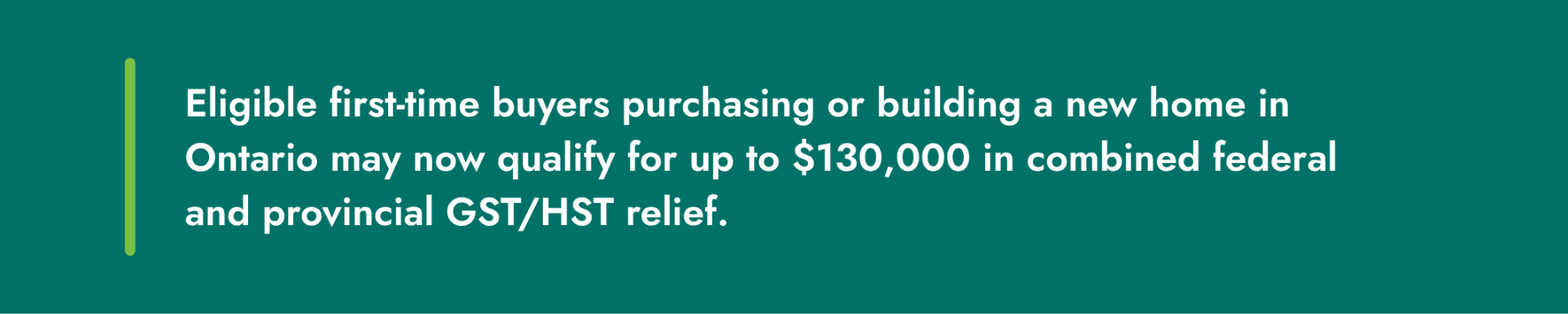
Buying a first home comes with enough numbers to think about already: the down payment, mortgage payment, closing costs, property taxes, and the amount you can comfortably afford each month. In 2026, there is another number worth understanding if you are considering a new home: up to $130,000.
The new federal First-Time Home Buyers’ GST/HST rebate received Royal Assent in March 2026, and applications are now open. Combined with Ontario’s rebate for eligible first-time buyers, it can significantly reduce the HST cost of purchasing, building or substantially renovating a qualifying home.
There is one important distinction to understand right away: this is primarily a new-housing incentive. An ordinary resale home does not qualify simply because you are a first-time buyer. The program applies to newly built homes, qualifying substantially renovated homes, certain co-op units and owner-built homes.
For buyers comparing a new build with resale properties, that difference can materially change the numbers.
What Is the First-Time Home Buyers’ GST/HST Rebate?
The first-time home buyer GST rebate in Canada reduces the GST, or federal portion of the HST, that eligible first-time buyers pay on qualifying new homes.
The federal rebate provides 100% relief from the GST, or federal portion of the HST, on a qualifying home valued at $1 million or less, up to a maximum federal rebate of $50,000. The rebate gradually declines for homes valued between $1 million and $1.5 million. At $1.5 million or more, the federal first-time buyer rebate is no longer available.
In Ontario, eligible first-time buyers may also qualify for the Ontario first-time home buyer rebate, which can provide up to $80,000 toward the provincial portion of the HST. The CRA confirms that this Ontario rebate is now available and follows the eligibility conditions of the federal program.
That means the potential relief can be substantial:
- Federal Rebate: Up to $50,000 of the GST or federal portion of the HST.
- Ontario Rebate: Up to $80,000 of the provincial portion of the HST.
- Potential Combined Relief: Up to approximately $130,000 for an eligible Ontario first-time buyer.
The new rebate generally applies to qualifying builder purchase agreements entered into on or after March 20, 2025, and before 2031. Construction and completion deadlines also apply.
This new program sits alongside the existing GST/HST New Housing Rebate. Where both apply, the first-time buyer rebate effectively acts as a top-up to the existing rebate rather than giving you the same tax back twice.
For the latest administrative details, see the CRA’s guidance on the first-time home buyer rebate and application process.
Who Actually Qualifies as a First-Time Buyer?
The definition of “first-time buyer” for this program is more specific than simply never having purchased a house before.
Generally, the first-time home buyers’ GST/HST rebate eligibility rules require you to:
- Be at Least 18: You must be 18 years of age or older.
- Meet Residency Status Requirements: You must be a Canadian citizen or permanent resident.
- Meet the Homeownership Test: You must not have lived in a home that you or your spouse or common-law partner owned, either in Canada or elsewhere, as your primary residence during the current calendar year or the previous four calendar years.
- Meet the Test on the Correct Date: For a home purchased from a builder, your status is generally tested when ownership transfers. Different timing rules apply to leased-land, co-op and owner-built homes.
- Not Have Claimed the Rebate Before: Neither you nor your spouse or common-law partner can have previously received an FTHB GST/HST rebate.
These rules can create situations that are not immediately obvious.
For example, suppose you owned and lived in a home that you sold in June 2022, then rented afterward. If ownership of your new home transfers to you in 2026, you would not qualify as a first-time buyer because 2022 remains within the previous four calendar years.
If ownership instead transfers in 2027, and all the other requirements are satisfied, 2022 falls outside the relevant period, and you could qualify. This is the same type of example the CRA uses to explain its calendar-year test.
If you are preparing for your first purchase, my first-time home buyer mortgage guidance covers the broader financing process, including pre-approval, down payments, and other programs that may be relevant.
What Kinds of Homes Actually Qualify?
Many buyers ask whether the GST rebate applies to resale homes. Generally, the answer is no. However, a home that meets the CRA’s definition of a substantial renovation may qualify, so “previously occupied” does not automatically exclude every property.
Qualifying housing can include:
- Newly Built Homes: A newly constructed house or condominium purchased from a builder for use as your primary residence.
- Substantially Renovated Homes: The CRA generally considers a substantial renovation to involve removing or replacing 90% or more of the interior of the existing home, subject to its specific rules.
- Owner-Built Homes: A home you build yourself or hire a contractor to build for use as your primary residence.
- Homes on Leased Land: Certain new homes may qualify where the land lease is at least 20 years or provides an option to purchase the land.
- Co-Operative Housing: A qualifying share in a newly built or substantially renovated housing co-operative may be eligible.
- Mobile or Floating Homes: Some newly built or substantially renovated mobile, modular, and floating homes may also qualify.
The CRA confirms these categories as part of the federal GST rebate for a new-build home in Canada.
If you are building your own home rather than purchasing a completed property, construction financing becomes another important part of the plan. Funds may be advanced in stages as construction progresses, so the mortgage strategy should be established well before work begins.
How Much Could You Actually Get?
If you are wondering how much the first-time home buyer rebate is, the answer depends primarily on the home’s value, the tax paid and which federal and Ontario programs apply to your transaction.
For the federal portion:
- $1 Million or Less: Up to 100% of the GST or federal portion of the HST, to a maximum of $50,000.
- Between $1 Million and $1.5 Million: The maximum federal rebate gradually declines.
- $1.5 Million or More: No federal FTHB GST/HST rebate is available.
For example, the CRA uses a $1.25 million home to demonstrate the phase-out. Because $1.25 million is halfway between $1 million and $1.5 million, the maximum federal rebate is reduced by 50%, from $50,000 to $25,000.
Ontario can provide up to another $80,000 of relief from the provincial portion of the HST for eligible first-time buyers. Depending on the home’s price and the specific transaction, total relief can therefore reach approximately $130,000.
There is also an important 2026 Ontario wrinkle. Ontario introduced a temporary Enhanced New Housing Rebate for certain eligible new-home transactions, generally involving agreements entered into from April 1, 2026 through March 31, 2027. That program can also provide up to $80,000 toward the provincial HST and may overlap with first-time buyer relief, but provincial rebates cannot simply be stacked beyond the applicable HST limits.
This is why two buyers purchasing similarly priced homes can have different rebate calculations depending on when their agreements were signed and which program applies.
Can You Use the Rebate Toward Your Down Payment?
This is where the tax calculation and the mortgage calculation need to be kept separate.
A rebate can reduce the final cost of a transaction, particularly when a builder agrees to credit an eligible rebate at closing. But I would not recommend assuming that a future rebate automatically replaces money you need for your required down payment.
Your lender still has to confirm your down payment, source of funds, purchase agreement, and transaction structure. The treatment can also depend on whether the builder’s purchase price is presented as HST-included or HST-extra and whether an eligible rebate is assigned to the builder or paid directly to you.
Until those details are reviewed, plan conservatively and make sure your down payment is properly documented.
How and When Do You Apply?
How you apply depends on whether you are purchasing from a builder or building the home yourself.
For a builder purchase, the builder may agree to pay or credit an eligible rebate at closing. If that happens, the builder generally submits the required rebate application. If the builder does not credit the rebate, you may need to apply to the CRA yourself after the transaction.
For an owner-built home, the process is different because you generally pay GST/HST on qualifying construction costs as the project progresses and then apply for the rebate when the applicable requirements have been met.
Applications usually have a two-year deadline. The exact starting point depends on the type of transaction, such as the date ownership or possession transfers or when construction is substantially completed.
For Ontario builder purchases, CRA documentation includes Form GST190 and the RC7190-ON Ontario Rebate Schedule.
One practical step can prevent a great deal of confusion: ask your builder early how the rebate is being handled.
Before closing, confirm:
- Whether the quoted purchase price includes HST;
- Which rebates have already been factored into that price;
- Whether you are assigning a rebate to the builder;
- Whether a rebate will be credited at closing; and
- Whether you will need to file your own claim afterward.
Do not assume that a rebate shown in marketing materials is automatically included in the price the same way on every agreement.
How Does the GST/HST Rebate Affect Your Mortgage?
In 2026, a GST/HST rebate on a new home in Canada can reduce your overall tax cost, but the lender still has to underwrite the actual transaction shown in your purchase documents. That makes the wording of the purchase agreement and statement of adjustments important.
When we review your financing, I want to know:
- Is the builder’s stated price HST-included or HST-extra?
- Has a rebate already been deducted from the advertised or contract price?
- Are you assigning an eligible rebate to the builder?
- Is the builder providing a credit at closing?
- Are you expecting a payment from the CRA after closing instead?
Those details help determine the funds you actually need and make sure your mortgage application reflects the transaction correctly.
They can also affect your planning under the mortgage stress test. A large tax rebate may improve the overall economics of buying a new home, but it does not change the lender’s need to verify your income, debts, down payment, and ability to carry the mortgage.
If you are still determining your borrowing range, my guide to understanding the mortgage pre-approval process explains how lenders look at your finances before you start making offers.
Does the Rebate Make a New Home Better Than Resale?
The new home GST rebate in Ontario for 2026 gives qualifying new construction a meaningful financial advantage, but a tax rebate should not make the decision for you. A new home and a resale property come with different costs, risks, and timelines.
A new build may involve longer closing timelines, construction delays, occupancy arrangements for some condominiums, upgrades, adjustments at closing and, where applicable, construction or progress-draw financing. Buyers of qualifying new homes in Ontario should also understand the protections available through Ontario’s new home warranty program, which is administered by Tarion.
A resale home may give you more certainty around the neighbourhood, existing finishes and move-in timing. Depending on your location and budget, there may also be substantially more resale inventory available than suitable new construction.
The rebate can narrow the cost difference, but it does not automatically make a new build the better financial decision.
Local market conditions matter as well. If you are purchasing in Eastern Ontario, my 2026 Kingston home-buying market update shows why inventory, pricing and your personal financial readiness should be considered alongside mortgage rates and incentives.
The better comparison is the overall cost and fit of each option, not just the purchase price after the rebate. Consider the mortgage payments, property taxes, condo fees where applicable, maintenance, closing costs, timing, and how long you expect to own the home.
How a Mortgage Broker Can Help You Navigate the Rebate
The CRA ultimately determines tax rebate eligibility, so a mortgage broker does not replace tax or legal advice. My role is to make sure the rebate and the financing are being looked at together rather than as two separate conversations.
We can review how the builder has structured the purchase price, how much cash you need to close, whether the rebate is expected at closing or later, and how the lender will assess the transaction.
If you are buying pre-construction or building your own home, we can also look at lenders that offer suitable construction or progress-draw financing and coordinate the mortgage requirements with the timing of the project.
This is one of the practical differences between simply receiving a mortgage quote and developing a financing strategy. My guide to why more Canadians are choosing mortgage brokers over banks explains how access to multiple lenders can help when the financing situation is less straightforward.
Buying Your First Home? Make Sure You Do Not Miss the Rebate
The new first-time home buyer tax rebate for 2026 can represent significant savings for an eligible buyer purchasing, building, or substantially renovating a home. In Ontario, the combination of federal and provincial relief can reach approximately $130,000.
But the headline number is only the starting point. Your eligibility, purchase price, agreement date, type of home, and the way your builder handles HST all matter. Just as importantly, the rebate needs to fit into a mortgage plan that works before and after closing.
If you are considering a new build or your first home, we can review the purchase structure, down payment, and financing together before you commit.
Book a Free Mortgage Call or Get Pre-Approved Today